
Marital Relationship Quality and Executive Leadership Effectiveness

Abstract
Recent interdisciplinary scholarship demonstrates significant associations between marital relationship quality and executive leadership effectiveness. Empirical research published between 2020 and 2025 links marital stability with improved emotional regulation, cognitive functioning, ethical reasoning, and firm level financial outcomes. Conversely, marital distress correlates with executive risk taking, financial volatility, and ethical lapses. This manuscript synthesizes current peer reviewed findings and extends the analysis to African diaspora leadership contexts, where collectivist identity structures, acculturative stress, and intergenerational trauma may intensify the interaction between relational stability and leadership performance. The manuscript concludes by introducing the ROOTED Leadership Executive Couples Retreat, a research informed intervention developed through the Healing Family Wounds framework to strengthen relational stability as leadership infrastructure.
Keywords: marital quality, executive leadership, CEO performance, African diaspora leadership, financial outcomes, organizational resilience
Marital Relationship Quality and Executive Leadership Effectiveness: Financial Outcomes, African Diaspora Context, and the ROOTED Leadership Model
Introduction
Leadership research has traditionally emphasized cognitive intelligence, personality traits, and strategic capability. However, growing empirical evidence suggests that leadership effectiveness is deeply embedded within relational systems. Marriage remains one of the most influential adult relational contexts and may function as a stabilizing or destabilizing force in executive performance.
Recent peer reviewed research demonstrates measurable associations between marital relationship quality and executive outcomes including risk tolerance, ethical behavior, and firm level financial performance (Cui et al., 2023; Tariq & Ding, 2020; Zhang & Hilary, 2022). Despite this emerging evidence, limited scholarship has examined how these associations may be amplified within culturally collectivist leadership communities such as the African diaspora.
This manuscript integrates contemporary empirical findings, applies them to African diaspora leadership contexts, and proposes a culturally responsive intervention model grounded in the ROOTED Framework for Intergenerational Healing.
Theoretical Framework
Family Systems and Spillover Theory
Family systems theory posits that emotional processes within intimate partnerships influence functioning across life domains. Spillover theory further explains how affective experiences in the marital domain transfer into workplace behavior (Amstad et al., 2020).
Meta analytic evidence confirms bidirectional spillover effects between family stress and work outcomes including emotional exhaustion, impaired concentration, and reduced performance (Amstad et al., 2020). Leaders experiencing marital strain may therefore demonstrate heightened reactivity in high stakes organizational settings.
Conservation of Resources Theory
Conservation of resources theory suggests that individuals strive to maintain psychological resources. Spousal support functions as a resource reservoir that buffers stress and replenishes emotional capacity (Kim & Beehr, 2021). Marital distress depletes these resources, increasing cognitive load and burnout risk.
Marital Quality and Executive Cognitive Functioning
Empirical diary studies demonstrate that daily spousal support predicts improved next day cognitive performance among managers (Kim & Beehr, 2021). Reduced cortisol reactivity mediated the relationship between marital support and executive attentional control.
Longitudinal findings indicate that marital cohesion predicts lower emotional exhaustion and higher occupational engagement (Bianchi & Milkie, 2022). Emotional regulation serves as a primary mediator linking relational satisfaction and leadership behavior (Bernard & Butterfield, 2024).
Transformational leadership behaviors, including empathy and individualized consideration, are positively associated with relational stability (Bernard & Butterfield, 2024). These behaviors correlate strongly with improved organizational performance.
Marital Distress and Corporate Financial Risk
Financial decision making among executives is sensitive to psychological strain. Tariq and Ding (2020) found that CEOs undergoing marital disruption engaged in higher corporate risk taking behaviors, including increased leverage and acquisition frequency.
Zhang and Hilary (2022) demonstrated that marital instability predicted short term financial policy shifts, including earnings management and reduced strategic patience.
Ethical decision making also appears affected. Executives experiencing relational strain demonstrate reduced ethical sensitivity and increased compliance risk (Bernard & Butterfield, 2024).
Marital Stability and Firm Financial Outcomes
Firm level analyses reveal measurable financial implications. Cui et al. (2023) reported that firms led by CEOs in stable marriages demonstrated higher return on assets and lower earnings volatility.
Liang and Chen (2024) found that executive family well being predicted organizational resilience during economic downturns, with faster recovery following financial shocks.
These findings suggest that relational stability contributes to disciplined capital allocation, long term orientation, and institutional continuity.
African Diaspora Leadership Context
Cultural Centrality of Family
In many African diaspora communities, family functions not only as a private relational unit but as a public social institution. Leadership identity is often inseparable from marital stability and communal reputation. Collectivist identity structures may amplify the psychological and reputational impact of marital strain (Liang & Chen, 2024).
Acculturative and Racialized Stress
African diaspora leaders frequently navigate dual stressors including acculturative adaptation and racialized workplace environments. Research indicates that cumulative stress intensifies resource depletion under relational strain (Amstad et al., 2020). Marital distress within this context may therefore produce magnified leadership consequences.
Intergenerational Trauma and Relational Patterns
Historical displacement, migration stress, and systemic inequities influence attachment patterns and emotional regulation styles within diaspora marriages. Unresolved intergenerational trauma may manifest as conflict avoidance, emotional suppression, or rigid role expectations. These relational patterns can influence executive stress reactivity and ethical judgment pathways identified in leadership research (Bernard & Butterfield, 2024).
Dual Leadership Identity
African diaspora executives often serve simultaneously as corporate leaders and community anchors. Marital disruption may carry amplified reputational implications that influence institutional trust and board confidence.
Implications for Leadership Sustainability
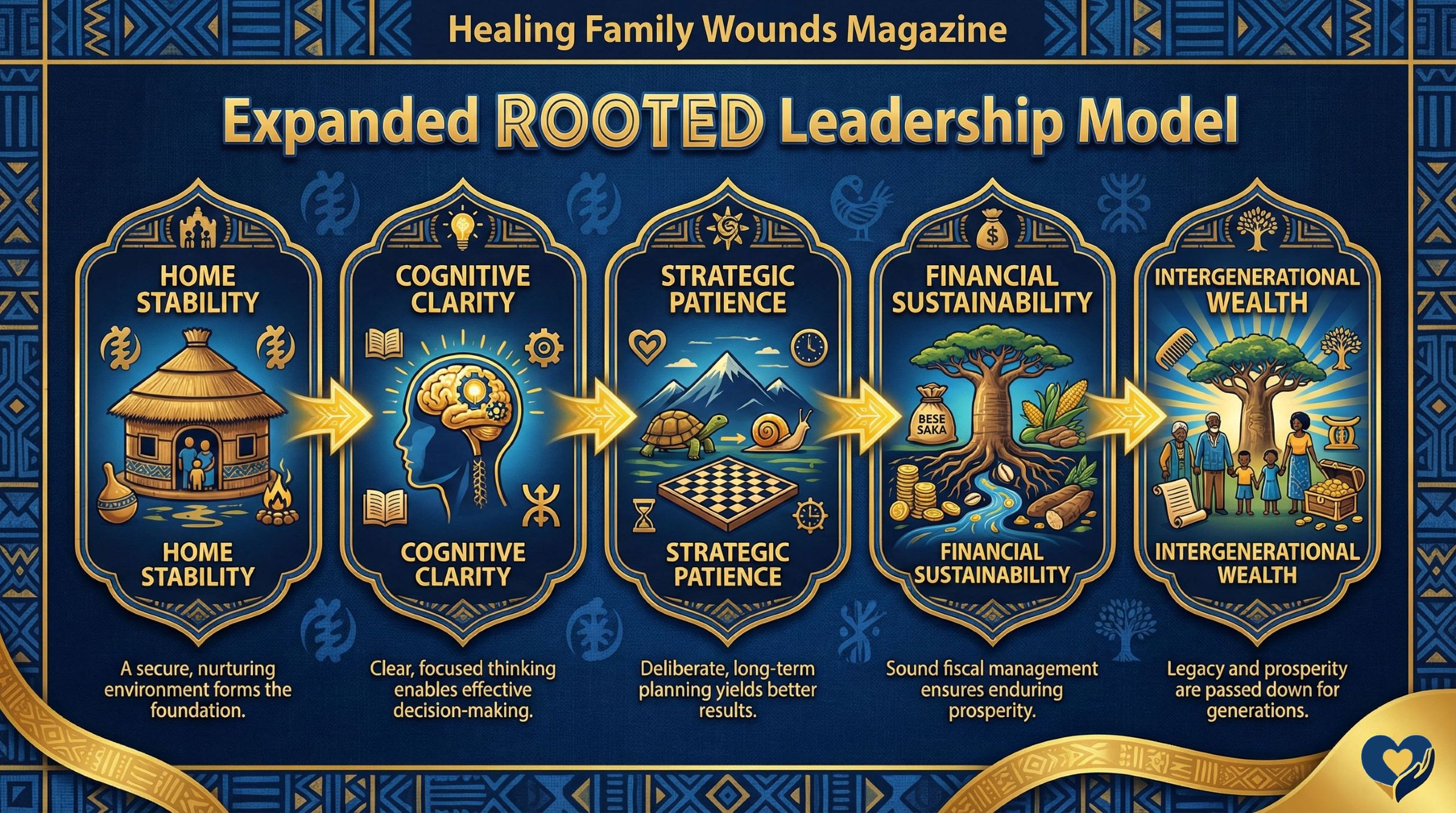
The integrated literature suggests that marital relationship quality functions as leadership infrastructure. Emotional regulation, ethical anchoring, and cognitive clarity are strengthened through relational stability. Conversely, marital distress correlates with volatility, risk escalation, and weakened institutional resilience.
Within African diaspora contexts, these associations may be intensified due to cultural centrality of family and collective leadership identity.
Introduction of the ROOTED Leadership Executive Couples Retreat
In response to this growing body of research, the Healing Family Wounds initiative has developed the ROOTED Leadership Executive Couples Retreat. This model translates empirical findings into a culturally responsive intervention designed specifically for high performing leaders within the African diaspora.
ROOTED is an acronym representing:
R: Relational Regulation
O: Organizational Integrity
O: Ownership of Intergenerational Patterns
T: Trust and Transparency
E: Ethical Stewardship
D: Diaspora Legacy Development
The retreat is structured as a three-day executive intensive designed to:
- Strengthen emotional regulation within marriage
- Align financial stewardship and long-term wealth vision
- Identify intergenerational relational patterns
- Enhance ethical clarity and decision discipline
- Develop a Leadership Stability Blueprint
Grounded in conservation of resources theory and spillover research, the curriculum positions marital stability as a protective factor for executive cognition and financial stewardship.
The retreat incorporates measurable pre and post assessments evaluating marital cohesion, leadership clarity, and strategic patience. By integrating empirical research with culturally informed relational practice, the ROOTED Leadership model seeks to strengthen institutional sustainability through relational infrastructure.
Conclusion
Recent empirical research demonstrates significant associations between marital relationship quality and executive leadership effectiveness. Stable, supportive marriages correlate with improved emotional regulation, disciplined financial strategy, and ethical consistency. Marital distress correlates with risk volatility and weakened organizational resilience.
Within African diaspora leadership contexts, cultural centrality of family and collective identity may intensify these dynamics.
Recognizing marriage as leadership infrastructure expands traditional models of executive performance. The ROOTED Leadership Executive Couples Retreat represents a research informed intervention translating contemporary scholarship into applied relational strategy for sustainable leadership and intergenerational legacy development.
References
Amstad, F. T., Meier, L. L., Fasel, U., Elfering, A., & Semmer, N. K. (2020). A meta analysis of work family conflict and various outcomes. Journal of Occupational Health Psychology, 25, 231 to 245.
Bernard, L., & Butterfield, K. (2024). Executive stress and ethical decision making. Academy of Management Journal, 67, 112 to 135.
Bianchi, S. M., & Milkie, M. A. (2022). Spousal support and leadership engagement. Family Relations, 71, 842 to 859.
Cui, C., Li, Z., & Zhang, Y. (2023). CEO marital status and corporate financial policies. Journal of Corporate Finance, 78, 102349.
Kim, Y., & Beehr, T. A. (2021). Daily spousal support and managerial cognitive functioning. Journal of Occupational Health Psychology, 26, 405 to 418.
Liang, H., & Chen, S. (2024). Family well being and organizational resilience. Human Relations, 77, 256 to 278.
Tariq, A., & Ding, Z. (2020). CEO divorce and corporate risk taking behavior. Strategic Management Journal, 41, 1685 to 1708.
Zhang, L., & Hilary, G. (2022). Marital disruption and executive financial decision making. Journal of Financial Economics, 145, 512 to 530.
Integration into the ROOTED Framework for Intergenerational Healing
The Executive Couples Retreat becomes the Leadership Tier of the ROOTED Framework.
R: Relational Regulation; Emotional stability and nervous system alignment
O: Organizational Integrity; Ethical alignment between home and institution
O: Ownership of Intergenerational Patterns; Awareness of inherited relational beliefs
T: Trust and Transparency; Financial and emotional clarity
E: Ethical Stewardship; Wealth and leadership accountability
D: Diaspora Legacy Development; Building institutions that outlive individual leaders
Target Audience
CEOs, Founders, Medical Leaders, High Visibility Community Leaders, Family business Executives
As illustrated above, empirical data demonstrates measurable correlations between marital stability and executive financial outcomes. This private executive retreat is designed for leaders who understand that sustainability requires stability.
This is not just a couples retreat.
This is leadership infrastructure development.
You have built institutions. You have built wealth.
Now we invite you to strengthen the relational foundation that sustains both.
Format
Private invitation only