
Immigration Trauma and Its Impact on the Mental Health of African Families Living in the Diaspora

Abstract
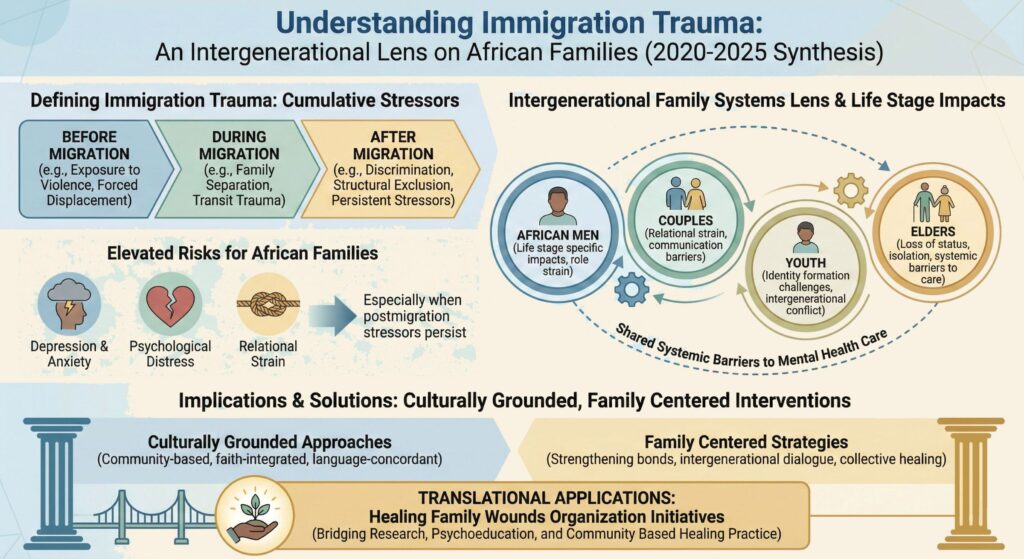
Immigration trauma encompasses cumulative psychological and social stressors experienced before, during, and after migration, including exposure to violence, forced displacement, family separation, discrimination, and structural exclusion. Recent scholarship indicates that African immigrant and refugee families experience elevated risk for depression, anxiety, psychological distress, and relational strain, particularly when postmigration stressors persist. This manuscript synthesizes peer reviewed literature published between 2020 and 2025 to examine how immigration trauma affects African men, couples, youth, and elders through an intergenerational family systems lens. Findings highlight life stage specific impacts and shared systemic barriers to mental health care. Implications are discussed for culturally grounded, family centered interventions, including translational applications through Healing Family Wounds Organization initiatives that bridge research, psychoeducation, and community based healing practice.
Keywords: immigration trauma, African diaspora, family systems, intergenerational transmission, culturally responsive mental health
Immigration Trauma and Its Impact on the Mental Health of African Families Living in the Diaspora: An Intergenerational Family Systems Analysis
Introduction
Global migration has significantly reshaped African family structures across the diaspora. While migration may offer safety and opportunity, it frequently involves layered trauma extending beyond individual experience into relational systems (Alegría et al., 2021). African immigrants and refugees may encounter adversity prior to migration, perilous transit conditions, and persistent postmigration stressors including racial discrimination, economic marginalization, credential devaluation, and legal insecurity (Kirmayer et al., 2021).
These cumulative stressors influence psychological functioning and disrupt family roles, communication patterns, and relational stability. Understanding immigration trauma as a systemic and intergenerational phenomenon is essential for developing culturally responsive interventions. This paper synthesizes recent empirical literature to examine the mental health impacts of immigration trauma across African men, couples, youth, and elders within diaspora contexts.
Conceptual Framework
Immigration trauma is conceptualized as the cumulative psychological burden across three phases: premigration, migration, and postmigration (Alegría et al., 2021). Family resilience theory suggests that stressors are mediated through relational processes such as shared meaning making, flexible role adaptation, and emotional communication (Walsh, 2021). When these processes become overwhelmed, distress may circulate across subsystems and transmit intergenerationally.
An intergenerational systems perspective highlights that parental trauma exposure may influence parenting behaviors, attachment patterns, and emotional modeling, thereby shaping youth outcomes. Similarly, role displacement among men and elders may alter family hierarchies and relational stability.
Method
A narrative review methodology was employed. Peer reviewed articles published between 2020 and 2025 were identified through PubMed, PsycINFO, and Google Scholar. Priority was given to empirical studies focusing on African immigrants and refugees. When African specific data were limited, high quality studies on immigrant populations with contextual relevance were included.
Studies examining depression, anxiety, psychological distress, family dynamics, and barriers to care were reviewed and synthesized thematically. Articles were evaluated for methodological rigor, population specificity, and relevance to family systems processes.
Findings
Impact on African Men
African migrant men experience significant psychological distress related to role strain, discrimination, and economic pressure (Abdikadir et al., 2024). Migration often disrupts traditional provider identities and social status. Masculinity norms emphasizing stoicism and emotional restraint may reduce help seeking behaviors and delay intervention.
Men frequently externalize distress through somatic complaints, irritability, or behavioral withdrawal rather than emotional disclosure. This pattern contributes to underdiagnosis of depression and anxiety within this population.
Impact on African Couples
Immigration trauma affects couples through acculturation stress, renegotiation of gender roles, and financial instability. A qualitative study of Nigerian immigrants in North America identified cultural transition and socioeconomic pressure as primary contributors to marital dissatisfaction (Ade Oshifogun et al., 2025).
Without structured communication and repair skills, stress accumulation may lead to chronic conflict or emotional disengagement. Interpersonal strain within couples may subsequently influence parenting quality and youth emotional stability.
Impact on African Youth
African immigrant youth face acculturative stress, racial discrimination, identity negotiation, and academic expectations. These stressors are associated with increased risk of anxiety and depressive symptoms (Lerias et al., 2024).
Parental trauma exposure and communication barriers further influence youth emotional regulation and help seeking patterns (Mbakogu, 2025). Bicultural identity strain may intensify when intergenerational misunderstandings remain unresolved.
Impact on African Elders
Older African immigrants may experience loneliness, language barriers, diminished social networks, and shifts in authority within multigenerational households. A qualitative study found elders reporting emotional isolation despite living with family members (Adeniji et al., 2025).
Cultural expectations emphasizing endurance may discourage emotional expression, contributing to silent depressive symptomatology.
Cross-Cutting Barriers to Mental Health Care
Across subsystems, barriers include stigma, mistrust of institutions, financial cost, limited culturally responsive providers, and fear of social consequences (Abdikadir et al., 2024; Alegría et al., 2021). These barriers reinforce silence and delay treatment, increasing risk of chronic and intergenerational transmission of distress.
Discussion
The findings underscore immigration trauma as a cumulative, relational, and intergenerational phenomenon. While men, couples, youth, and elders experience distinct stressors, their mental health outcomes are interconnected.
Culturally grounded family centered interventions are essential. Psychoeducation models that normalize emotional expression while honoring cultural values may reduce stigma and enhance resilience. Translational community platforms that integrate research, storytelling, and structured relational practice can bridge the gap between academic knowledge and lived experience.
Programs that emphasize relational safety, identity integration, emotional literacy, and intergenerational dialogue are particularly promising in mitigating long term depressive outcomes.
Implications for Practice and Future Research
Interventions should:
- Address intergenerational trauma transmission
- Normalize help seeking within culturally congruent frameworks
- Strengthen family communication and role flexibility
- Increase access to culturally responsive care
Future research should examine longitudinal mental health trajectories among African diaspora families and evaluate the efficacy of family centered psychoeducational interventions.
Conclusion
Immigration trauma significantly influences the mental health of African families living in the diaspora. Cumulative stressors across migration phases affect men, couples, youth, and elders in distinct yet interconnected ways. Addressing these impacts requires culturally responsive, family centered approaches that strengthen relational systems and reduce stigma. Translational platforms that integrate research with community engagement can play a vital role in advancing intergenerational healing.
References
Abdikadir, F., et al. (2024). African migrant men’s experiences and preferences for formal mental health help seeking: A meta synthesis. International Journal of Mental Health Systems, 18(1), 1 to 15.
Ade Oshifogun, J., et al. (2025). Perceived causes of marital dissatisfaction among Nigerian immigrants in North America. PLOS ONE, 20(3), e0327551.
Adeniji, D. O., et al. (2025). “Nowhere to go”: Older African immigrants’ experiences of loneliness. Journal of Aging Studies, 72, 101254.
Alegría, M., Alvarez, K., & DiMarzio, K. (2021). Immigration and mental health. Current Epidemiology Reports, 8(3), 145 to 155.
Kirmayer, L. J., et al. (2021). Common mental health problems in immigrants and refugees. Canadian Medical Association Journal, 193(9), E299 to E305.
Lerias, D., et al. (2024). Acculturative stress and immigrant youth mental health: A scoping review. Journal of Immigrant and Minority Health, 26(2), 345 to 358.
Mbakogu, I. (2025). Parenting practices and access to mental health and substance use care among immigrant and refugee youth of African descent in Nova Scotia. Adolescents, 5(3), 100.
Walsh, F. (2021). Family resilience: A dynamic systems framework. Family Process, 60(2), 488 to 503.