
Marriage as Leadership
Relational Intelligence, Emotional Safety, and Executive Functioning Among African Diaspora Couples
Gladys Beri
Healing Family Wounds Organization
Research Division for Intergenerational Healing and African Family Systems
Abstract
Marriage has traditionally been conceptualized as a private relational institution; however, emerging evidence suggests that intimate relationships significantly influence psychological functioning, leadership effectiveness, occupational performance, stress regulation, and overall well being. For African diaspora couples occupying leadership positions in business, government, healthcare, ministry, education, entrepreneurship, and community organizations, marriage often functions as a relational leadership system that directly affects decision making, emotional regulation, resilience, and intergenerational outcomes.
Despite substantial professional achievement, many high functioning couples experience emotional disconnection, unresolved trauma responses, migration related stressors, and competing cultural expectations that undermine relational satisfaction and collaborative leadership. This article introduces the construct of Marriage as Leadership, defined as a collaborative relational system requiring emotional safety, relational intelligence, shared accountability, conflict repair capacity, and co regulation. Drawing upon attachment theory, family systems theory, leadership research, emotional safety literature, migration studies, and African relational worldviews, this paper examines how trauma adaptations including emotional withdrawal, over functioning, perfectionism, control, and silent endurance may erode both relational functioning and leadership effectiveness.
The article further proposes the ROOTED™ Framework for Intergenerational Healing as a culturally responsive intervention model designed to strengthen emotional safety, relational competence, collaborative leadership, and legacy development among African diaspora couples. Implications for clinicians, executive coaches, leadership consultants, organizational systems, and community leaders are discussed.
Keywords: marriage, leadership, emotional safety, African diaspora couples, relational intelligence, attachment theory, executive functioning, trauma adaptation, intergenerational healing
Introduction
Leadership research has historically focused on organizational systems, workplace performance, executive decision making, and team effectiveness. Comparatively little attention has been devoted to the relational systems that sustain leaders outside organizational environments. Yet growing evidence suggests that attachment security, psychological safety, interpersonal trust, and relationship quality significantly influence occupational performance, resilience, emotional regulation, and burnout outcomes (Warnock et al., 2024; London & Zyberaj, 2025).
For African diaspora couples, marriage frequently serves as more than an intimate partnership. It functions as a social, cultural, economic, and intergenerational institution carrying expectations related to family leadership, community representation, cultural continuity, and legacy stewardship. Migration often creates opportunities for educational advancement, economic mobility, and professional success. However, the psychological and relational demands associated with migration may simultaneously intensify stress exposure, identity negotiation, role restructuring, and emotional isolation (Puzzo et al., 2024).

Many high achieving African couples successfully navigate demanding careers while privately struggling with emotional disconnection, chronic stress, unresolved trauma adaptations, communication difficulties, and relational exhaustion. Public competence may coexist alongside private relational strain. Consequently, leadership effectiveness cannot be fully understood without examining the quality of the relational system that supports leaders outside the workplace.
This article argues that marriage should be conceptualized as a leadership ecosystem requiring relational intelligence, emotional safety, collaborative governance, and intentional legacy development. Such a perspective may offer a more comprehensive understanding of executive well being, family resilience, and intergenerational flourishing.
Marriage as Leadership:
A New Conceptual Framework
Marriage as Leadership is defined as:
A collaborative relational system in which two individuals engage in shared governance through emotional safety, relational accountability, co regulation, conflict repair, effective communication, mutual influence, and intentional stewardship of family and community legacy.
This conceptualization extends traditional understandings of marriage beyond companionship and satisfaction. Rather, marriage becomes a dynamic leadership structure through which partners influence emotional climate, family functioning, decision-making processes, stress regulation, and intergenerational development.
Within this framework, relational intelligence represents a critical form of leadership capital. Relational intelligence refers to the capacity to accurately perceive, regulate, communicate, and respond to emotional and interpersonal dynamics in ways that promote trust, collaboration, and psychological safety.
Recent organizational research has increasingly highlighted the importance of attachment security, psychological safety, and supportive relational environments in promoting thriving, trust, and leadership effectiveness (Goel et al., 2025; Warnock et al., 2024). Although much of this research has focused on workplace relationships, similar mechanisms likely operate within intimate partnerships.
Attachment Theory and Relational Leadership
Attachment theory remains one of the most influential frameworks for understanding adult relational functioning. Attachment orientations influence emotional regulation, trust formation, conflict responses, vulnerability capacity, and help seeking behaviors across the lifespan (Mikulincer & Shaver, 2019).
Research increasingly demonstrates that attachment processes extend into leadership and organizational contexts. A recent meta analysis involving more than 32,000 participants found significant associations between attachment security, burnout, job satisfaction, organizational commitment, trust, and performance outcomes (Warnock et al., 2024). Similarly, secure attachment has been associated with greater thriving, trust, and positive perceptions of leadership relationships (Goel et al., 2025).
Within intimate partnerships, attachment insecurity may manifest through emotional withdrawal, hyper independence, excessive self reliance, controlling behavior, conflict avoidance, emotional reactivity, or chronic reassurance seeking.
While these adaptations often emerge as protective responses to earlier relational experiences, they may undermine emotional safety and relational stability within marriage.
For executive couples facing substantial occupational demands, attachment insecurity may create additional vulnerability to relational disconnection, burnout, and ineffective communication.
Trauma Adaptations and Executive Relationships
Trauma adaptations are often misunderstood as personality traits rather than survival strategies. Individuals who experienced chronic stress, attachment disruption, emotional neglect, parentification, or adversity frequently develop adaptive strategies designed to maintain safety, belonging, or predictability.
Among high-functioning adults, these adaptations commonly include:
- Emotional withdrawal
- Perfectionism
- Hyper responsibility
- Over-functioning
- Silent endurance
- Excessive self-reliance
- Control-based communication
- Conflict avoidance
- Emotional suppression
- Achievement-based identity formation
While these patterns may contribute to professional success, they can simultaneously inhibit vulnerability, emotional intimacy, collaborative problem solving, and relational repair.
Research examining attachment within workplace contexts has consistently found associations between insecure attachment, burnout, stress reactivity, diminished trust, and reduced relational effectiveness (Warnock et al., 2024). These findings suggest that trauma adaptations may have important implications not only for intimate relationships but also for leadership functioning and organizational outcomes.
African Diaspora Couples and Migration Stress
Migration represents both opportunity and disruption. African diaspora couples frequently navigate complex transitions involving cultural adaptation, economic pressures, changing gender roles, family obligations, racialized experiences, and altered support networks.
The migration experience often creates tension between collectivist cultural values and individualistic Western social systems. Couples may simultaneously manage professional advancement, transnational family responsibilities, financial remittances, cultural preservation efforts, and parenting challenges within unfamiliar social contexts.
These stressors can contribute to chronic emotional exhaustion, relational strain, and role conflict. Without intentional relational practices, couples may become highly efficient operational partners while experiencing diminished emotional connection.
Understanding marriage within diaspora communities therefore requires attention to migration related stress, bicultural identity development, and intergenerational family expectations.
Emotional Safety as Executive Capital
Psychological safety has emerged as a central construct within leadership research. Emotional safety refers to the experience of being accepted, respected, emotionally protected, and able to engage authentically without fear of humiliation, rejection, or retaliation.
Research suggests that psychologically safe relational environments facilitate trust, communication, learning, collaboration, and resilience (London & Zyberaj, 2025; Navas Jiménez et al., 2025). In contrast, emotionally unsafe environments contribute to stress activation, defensiveness, withdrawal, and reduced relational functioning.
Within marriage, emotional safety serves as a foundational leadership resource. Emotionally safe couples demonstrate greater conflict repair capacity, emotional openness, collaborative decision making, and adaptive coping during periods of stress.
Accordingly, emotional safety may be conceptualized as a form of executive capital that strengthens both relational and leadership effectiveness.
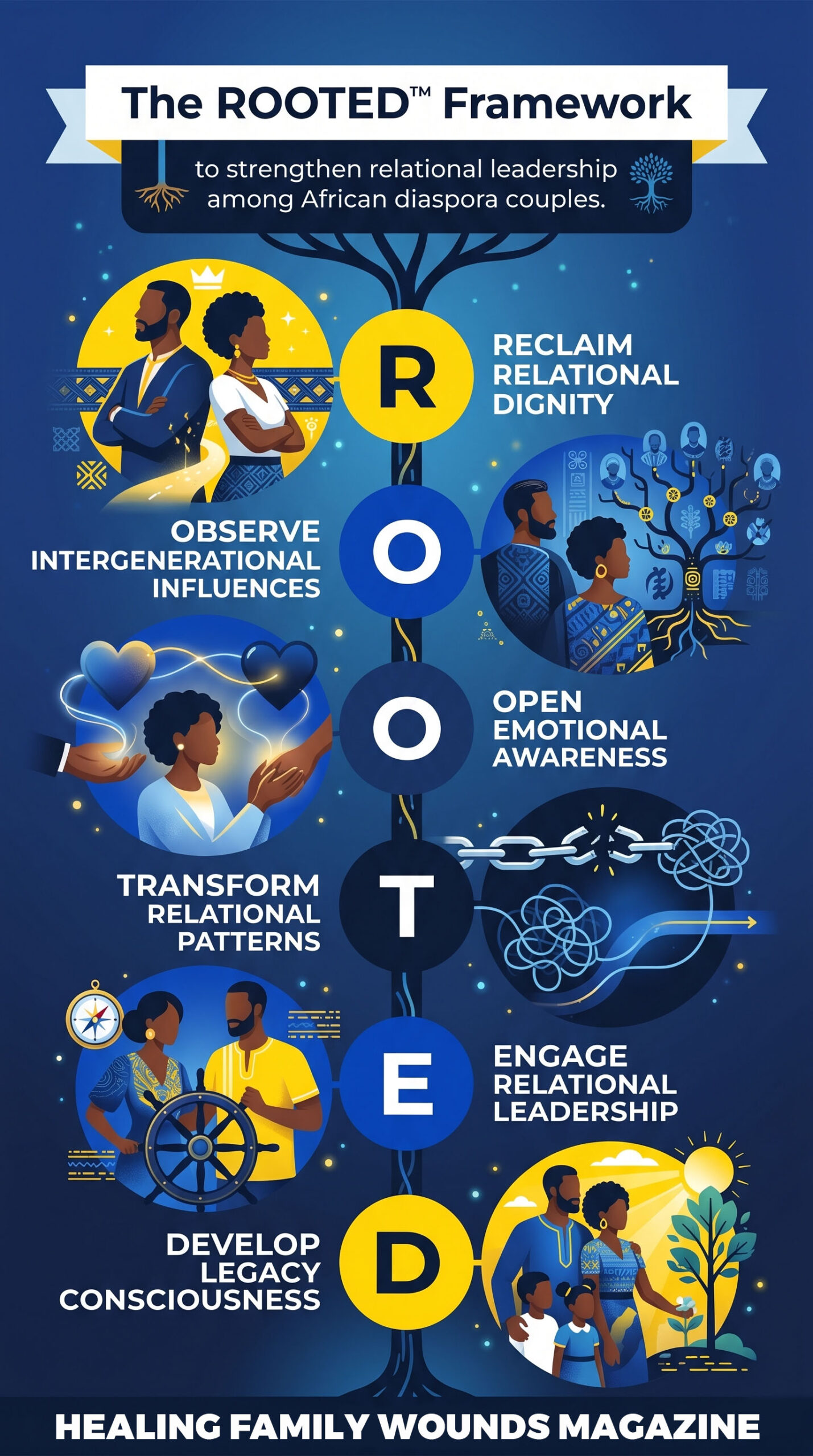
The ROOTED™ Framework for
Intergenerational Healing
The ROOTED™ Framework provides a culturally responsive intervention model designed to strengthen relational leadership among African diaspora couples.
Reclaim Relational Dignity: Identifying inherited narratives, trauma adaptations, and relational patterns that undermine emotional connection.
Observe Intergenerational Influences: Examining family legacies related to silence, emotional suppression, gender expectations, conflict management, and relational roles.
Open Emotional Awareness: Developing emotional literacy, vulnerability capacity, and awareness of nervous system responses.
Transform Relational Patterns: Replacing trauma driven survival strategies with emotionally safe communication and collaborative leadership practices.
Engage Relational Leadership: Cultivating accountability, effective communication, conflict repair, and shared decision making.
Develop Legacy Consciousness: Creating intentional family cultures that promote emotional safety, resilience, relational competence, and intergenerational flourishing.
Conclusion
Marriage among African diaspora couples represents a significant yet understudied leadership system. The quality of this relational system influences emotional regulation, executive functioning, leadership effectiveness, family resilience, and legacy development. Viewing marriage through a leadership lens offers a valuable framework for understanding how relational intelligence, emotional safety, and collaborative governance contribute to both private well-being and public influence.
The ROOTED™ Framework provides a culturally grounded approach for strengthening emotionally safe leadership systems within marriages and supporting healthier intergenerational outcomes for future generations.
References
- Fein, E. C., Benea, D., Idzadikhah, Z., & Tziner, A. (2020). The security to lead: A systematic review of leader and follower attachment styles and leader member exchange. European Journal of Work and Organizational Psychology, 29(1), 106–125. https://doi.org/10.1080/1359432X.2019.1696774
- Goel, R., Game, A. M., & Sanz Vergel, A. I. (2025). Are you secure enough to follow? The influence of follower attachment on transformational leadership perceptions and thriving at work. Journal of Business and Psychology, 41, 285–302. https://doi.org/10.1007/s10869-025-10045-4
- London, M., & Zyberaj, J. (2025). Developing leader follower relationships through improved communication, functional support, and secure attachment style: A conceptual review. Advances in Developing Human Resources. https://doi.org/10.1177/15344843251384341
- Navas Jiménez, M. C., Laguia, A., Schettini, R., Rodríguez Batalla, F., Guillén Corchado, D., & Moriano, J. A. (2025). When leaders are safe havens: How secure base leadership buffers the impact of emotional demands on exhaustion. Merits, 5(1), 3. https://doi.org/10.3390/merits5010003
- Puzzo, G., Sbaa, M. Y., Zappalà, S., & Pietrantoni, L. (2024). The impact of cultural intelligence on burnout among practitioners working with migrants: An examination of age, gender, training, and language proficiency. Current Psychology, 43, 4443–4457. https://doi.org/10.1007/s12144-023-04641-x
- Warnock, K. N., Ju, C. S., & Katz, I. M. (2024). A meta analysis of attachment at work. Journal of Business and Psychology, 39, 1239–1257. https://doi.org/10.1007/s10869-024-09960-9